


Now Enrolling: EA2251 for Patients With Advanced Biliary Tract Cancer
November 19, 2026From the Co-Chairs, November 2026
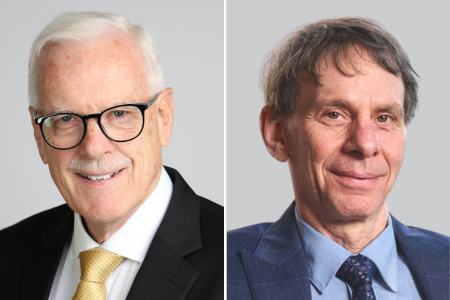
By Peter J. O’Dwyer, MD (left)
and Mitchell D. Schnall, MD, PhD
Our recent Group Meeting in Philadelphia was a resounding success, one of the best-attended meetings ever, with over a thousand participants. As always, the formal beginning was the Comis Translational Science Symposium, this time focused on a very current (and very targetable) driver of malignancy at all stages from initiation to metastasis: inflammation. The content was relevant to practically every therapeutic committee, and we urge you to view the session recording if you missed it. And if you did, please plan to be there for the next one: the goal of these symposia is to stimulate research ideas based on the best and most current science!
Our second plenary session was the General Session. There, we brought a novel focus on the cities where our member institutions are based. We began with Philadelphia (our fair city) that houses no fewer than three comprehensive cancer centers. Introduced by Dr. Margaret Foti, CEO of the American Association for Cancer Research, each of the cancer center directors (Dr. Chapman of the University of Pennsylvania's Abramson Cancer Center, Dr. Vonderheide of Thomas Jefferson University's Sidney Kimmel Comprehensive Cancer Center, and Dr. Winn of Fox Chase Cancer Center) outlined the major research initiatives underway, and the potential for collaborative studies. This segment was followed by presentations highlighting results from two high-impact studies: EA5142/ANVIL in lung cancer and E1A11/ENDURANCE in multiple myeloma. The General Session concluded with a celebration honoring Dr. Robert Gray, who recently stepped down as Group Statistician, Therapeutics, followed by his keynote lecture. During his talk, he reflected on changes in oncology clinical trials over the course of his career, examining how advances in technology, study design, outcome prediction, and the use of external data could improve trial efficiency while emphasizing the continued importance of rigorous randomized evidence.
In other news, we are pleased to report that we joined the chairs of the other five National Clinical Trials Network cooperative groups in a meeting with National Cancer Institute Director Dr. Tony Letai to discuss our shared interest in accelerating scientific progress by addressing barriers to study activation. Delays have accumulated over many years, including in idea generation from concept to protocol, in (count them!) six separate levels of review from the time a concept leaves ECOG-ACRIN to final approval of a protocol. Other processes, statistical, and regulatory factors that can contribute to delays were also discussed, along with potential solutions, including applying lessons learned from public-private partnerships (PPPs) in correlative science to clinical research. In this we applaud the decision of Dr. Letai to accelerate the development of therapeutic cancer vaccines in a PPP based in the Foundation for the National Institutes of Health, and hope that this can be a model we replicate through other means. Dr. Letai requested a White Paper, and we have submitted this to him. It is currently being edited for publication.
Further to the issue of therapeutic vaccines, a ground-breaking trial of neoantigen-directed individualized vaccines for melanoma patients was presented at ESMO in late October. We are indeed grateful to Dr. Janice Mehnert for penning a summary of the research in this issue to share with our membership. Leveraging the consequences of the disordered biology of the cancer cell to produce mutated proteins that are not necessarily participants in tumor progression, the development of these therapies is a generational step forward in immunological therapeutics, with much promise for future applications.
Read the November 2026 issue here.
